An April Fool Prank +50 years

An April Fool Prank +50 years

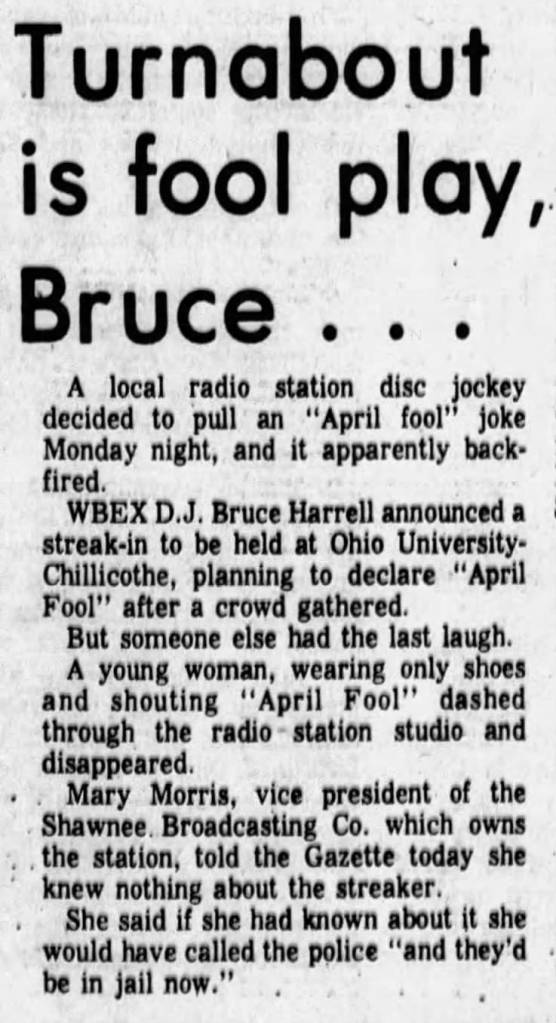
I came to the realization earlier today that 50 years ago, I was on the radio and needed to pull off a prank. With the help of a young woman, I was able to accomplish my mission. Here’s the scoop…

On a cool and rainy night fifty years ago, I teamed with an OU-C classmate to promote a “Streak In” at the OU-C parking lot on WBEX. A small group of people came to the station just before the April Fool was announced – one of them, a young woman, exposed her breasts, much to the amusement of the group she was with, the classmate helping me in the ruse, and me.

I stayed after the station signed off and filed a modified version of the story to the Associated Press. The Chillicothe Gazette took notice and I was on the front page the next afternoon, to the amusement of my co-workers and the young woman helping me with the ruse.

The VP mentioned was in her late seventies at the time and was the only person at the station not amused by the antics from the previous evening.

Be Seeing You!

Paper Cuts

Paper Cuts

A portion of my “Good Wednesday” was spent taking care of business I should have been filing quite some time ago. I was halfway through the job when I realized the most dangerous part of going through Chemotherapy.

Paper cuts.

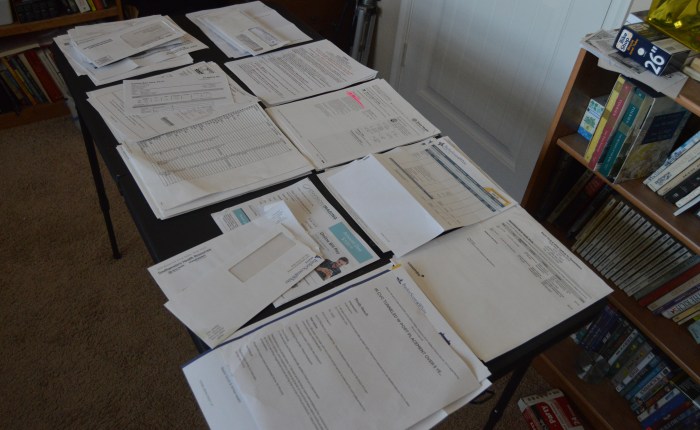
When I dragged out my foldable utility trailer last night for Halloween, I decided to use it as a way to organize the various dregs and vestiges of reminders and notices connected with the various doctors’ appointments and gymnastics associated with those same appointments. Between going to get a haircut (maybe to lose it before Christmas) and heading off to the pharmacy to get a flu shot, I separated enough pieces of paper to put a CVS sales receipt to shame.

All in all, I had at least thirteen different classifications of paperwork covering at least five doctors, four different medical buildings, three Nurse Practitioners, two different drug stores, and a Partridge in a Pear Tree.

How that partridge got there, I have no idea. Perhaps it has something to do with this being the first of November.

It should be noted that with all that I have collected, I was able to toss half again as much without really trying. I mean, do I really need to keep a roster of sports teams provided by my opthalmologist as a way to test my vision? I didn’t think so.

To be honest, part of my collection of paper is really my own fault. I prefer the proverbial paper trail to relying on the “Cloud” to be able to recall important documents. Part of that has to do with having gone through high school in a town with a paper mill. Gotta keep those folks working!

And then I sit down at the end of the day, contemplating doing the actual filing in the morning, and I look up from the laptop to realize that there is a whole ‘nother bunch of paper in my “In” box that needs attention – including a stack of old photos of “Cousin Julius” forwarded to me by my youngest sister. Somehow, she thinks that I am the family historian… and that’s because I have an old copy of LIFE magazine showing Cousin Julius’ 102nd birthday party. Our grandmother is in the article, uncredited, but she is there none the less. (Sweet Mary Pickford was at the party for Cousin Julius. It was quite the article.)

But I digress.

I have a goal to have a clean desk by the time I head off to the clinic to be infused next Wednesday. I hope that by then, I will find out whether or not I really belong there!

Be Seeing You!

A Fishy Little Tail

A Fishy Little Tail

I ran across an interesting little piece of trivia a few whiles back regarding Woodstock, Captain D’s Seafood restaurants, and Long John Silver’s restaurants. It seems that the first Captain D’s opened on August 15, 1969… the same day as the start of the famous Woodstock Music Festival held in upstate New York. The Festival’s last day was on August 18, 1969… the same day that the first Long John Silver’s launched.

I posted that little piece of trivia on my Facebook page the other day with some interesting responses, including from a woman claiming to be from Dayton Ohio who wanted me to add her to my friends list. She persisted, even though I indirectly accused her of “Catfishing.” Long story short, she is blocked from seeing what I do on Facebook.

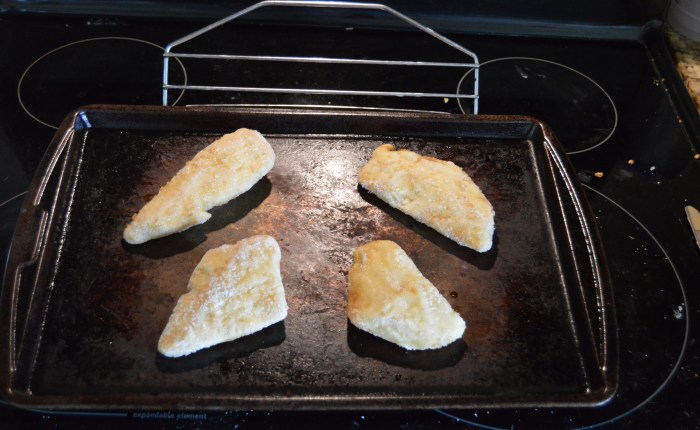
Anyhoo, I had my first encounter with Captain D’s while on my way to Savannah this past June. To that point, I had been a semi-regular of Long John Silver’s for quite some time. For the most part, I liked what they offered, but one can do only so much with fish and chips, battered and deep-fried. In the absence of Arthur Treacher’s Fish and Chips, and the ever more elusive Alfie’s Fish and Chips (There’s only one, now, in Lompoc California), LJS was pretty much a safe bet… and they were pretty much everywhere. The better half and I stopped at Captain D’s in Fort Valley Georgia. I appreciated the fact that they offered different kinds of fish served in ways other than being battered and deep-fried. Besides, the staff was friendly. If I lived there, I would likely be a regular and know at least one of the staff by name.

(As an aside, I was a regular at Alfie’s Fish and Chips in Chillicothe Ohio and one of the staff was a classmate of mine – Sue Costoff. I’m mentioning this because Sue passed recently. She was an interesting person in her own right and she will be missed by many.)

Back to the tale.

Something I noticed on the trip to Georgia was the numerous Catfish Farms going through Alabama. They were almost as prolific as the Solar Farms on the same stretch of road. While a lot of people love farm-bred catfish, I’m not so fond of it. While I was working offshore, I could count on there being catfish on the menu every Friday for at least one of the meals. One of the summers I worked on the rigs, the rig I was on was towed up to New England, off Nantucket. I looked forward to there perhaps being some variety on the Friday night menu, but I ended up being disappointed. The catering crew would go to the trouble of having farm-fed catfish every Friday. The southern boys I worked with had a latent distrust of us “Yankees” and our fancy New England seafood. I deliberately delayed a flight back to Houston so I could revel in real seafood at a real seafood restaurant in Boston.

I don’t limit my seafood preferences to ocean creatures. The better half has, on more than one occasion, told of living in Colorado. Her parents would go trout fishing in the early morning to catch trout for breakfast. I love trout when I can get it. When the better half recounts those stories, I find my mouth watering at the prospect of going somewhere for some broiled trout.

There was a “Farmer’s Market” held at the Tractor Supply parking lot this morning and one of the vendors was selling fishing gear. I spoke with him because of his hat, indicating that he was a fan of West Virginia University. The gear he had on display was purchased in West Virginia on what he called an annual trip back east. He would clean up and restore the gear before selling it at various flea markets in my little corner of the DFW Metromess. No doubt that he makes back the money spent on the trip and a little more to boot. Nice to have some extra money to spend here and there.

Enough fish.

There is one other piece of trivia I’ve encountered, having to do with excess money. A gentleman by the name of Godfrey Hounsfield had an idea on how to take multiple X-Ray photographs of the human body as a diagnostic tool. He took his idea to a British company that had a surplus of money thanks to a successful deal with a “Guitar Band” of note. Hounsfield’s invention, the CAT scan, was introduced to the world in 1972 thanks to the people at EMI labs. Their surplus of money came from deals they had with The Beatles!

The woman usually at the reception desk at Texas Oncology (where I go to have CAT scans) is a Beatlemaniac. Somehow I think she is secretly pleased.

Enough rambling on a Saturday Afternoon.

Be Seeing You!

Roller Skates

Roller Skates

A few months back, the better half’s car bit the dust and had to be replaced. She really wanted an electric, but electric then (as now) is a bit out of our price range. What we got instead was a small, Korean-made Chevrolet Spark. I call it the “Roller Skate.” Now that we’ve had it a few months, I’m starting to like our Roller Skate. It’s zippy, eats very little gasoline, and darn it, the Roller Skate is fun to drive!

I had forgotten how fun driving a diminutive car can be. Two of my favorite cars were Roller Skates, too!

The first car I ever owned was a 1969 Austin America. I paid something like $350 for a slightly larger version of the Mini. It needed work, and as I worked for the MG/Austin dealership at the time, I ended up getting an education about how cars work – or how British cars of the era worked. British cars had a terrible reputation, especially for the electrical parts made by Lucas… nicknamed “The Prince of Darkness.” The only electrical problem I had during my time with what my father called “The Little Yellow Monster” was with the starter. It ate up starter drives. I finally broke down, bought a second starter, keeping it reserve so when one starter failed a replacement was readily available.

I could change starters in five minutes flat.

When the Austin ran, it ran quite well and was perfectly suited for the driving I was doing at the time. And she could corner. I scared the snot out of a college roommate by taking a 25 MPH curve at 50. Looking back, I was damn lucky neither one of us was killed during that maneuver.

The Austin eventually died, a cracked head which I almost fixed was the culprit. I sold it for $50 as a parts car to a mechanic I knew. Both of us were happy with the deal.

My second Roller Skate was a Renault 5, with little letters on the side declaring it to be a LeCar. The car was manufactured and sold before Renault and AMC hooked up in the mid-seventies. The dealer was glad to be rid of the car as it was sitting in his back lot for over a year. I traded a troublesome Mustang II and was happier than the proverbial Pig in Mud with my purchase.

On my way home from the dealer, I was side-tracked by a collection of Corvettes in a mall parking lot. They had set up a track, of sorts, with cones, and for $20 (Donated to Big Brothers/Big Sisters), you could run through the course with the best time of the day being awarded with a trophy. I had $20 and took my turn. Second-Best-Time-of-the-Day. There were more than several Corvette drivers with their jaws on the ground. My performance probably generated another $200 – $300 from drivers attempting to best the time of my Roller Skate.

“Froggy LeCar” as I called her was usually reliable and stayed with me for the better part of three years. I managed to load the car up with most of my belongings and drove it down to Houston where I had a job waiting for me in the Oil Patch. I was waylaid in Memphis when I had a problem with the car running. A tune-up was all it needed. Did another overnight in LaFayette Louisiana where I got a phone call in my hotel room from a strange woman wanting to invite herself over to see me. It was my first time being solicited by a prostitute, but I didn’t realize it until sometime the next day while crossing the Sabine River.

I eventually let “Froggy” go, as it had no Air Conditioning. If you’ve ever lived in Houston, you’d know that AC is mandatory. I almost regret letting the car go. It was zippy and easy on gas.

Just like the better half’s Spark.

My little Jeep is larger and can carry more. Willy (Willy the Jeep – for somewhat obvious reasons) has been my favorite for most of seven years, but the Spark… well… there’s a part of me that wants to commandeer the Spark and call it my own.

For old time’s sake.

Be Seeing You!

Seventh Grade

Seventh Grade

A question posed the other day on Facebook asked why square dancing was included in physical education classes. The question was, more specifically, about why fourth graders were square dancing in physical education classes. My answer was based on having had square dancing taught when I was in the seventh grade. The classes went a long way towards teaching basic social skills to boys and girls undergoing the changes brought about by puberty. At least that’s the way I look at it over my shoulder. It was useful in that it was one of the first times us seventh-grade boys came to the realization that girls didn’t have or pass along the dreaded “cooties!”

That being said, there is nothing filthier than the mind of a seventh-grade boy.

Seventh-grade is about the time when certain changes start happening in our bodies. Formerly flat-chested girls start to develop breasts, something noted by seventh-grade boys. Seventh-grade girls are well aware of the reactions of seventh-grade boys and some of the, shall we say, less gifted of the girls attempted to “pad their resumes.” There were several instances of boys telling other boys about seeing bits of tissue peeking out of the shirts of certain girls. Those certain girls usually were friends with other girls who developed at a faster rate. They just wanted to keep up.

I found that the girls worth talking to were unconcerned about what other girls thought. Flat-chested or quickly developing, it didn’t matter to me. Much. I was surprised when a girl I met up with at a seventh-grade mixer showed up in a dress which hinted at her bosom not being augmented by tissue. Of course, I was asked about it by one or two of the other boys, but I said nothing. She had become too good a friend to betray her trust.

Many of the other boys were dealing with issues of their own, including nocturnal emissions and communal showers after gym class where they were noticing that they had hair “in places where they didn’t have hair before.” There were gross jokes about parts of the anatomy between the shoulders and the knees of both genders, as well as size comparisons not usually mentioned in polite company.

It was square dancing which became the equalizer. The division between the girls’ side and the boys’ side of the gym was gone. Had something to do with basketball. And the entire gym became a dance floor. We’d pair up, form squares, and learned the basics, all while learning valuable social skills and generally having a good time. For once, some of the filthy minds of the seventh-grade boys were tempered by having to interact with seventh-grade girls with (undoubtably) similar mind sets.

I put aside square dancing for a couple of decades, coming back to it when the first spouse suggested we take square dancing lessons. We had fun for a while, enjoying the company of other dancers who would burn off calories, only to get them back by stopping at the Big Boy on the way back home.

It has been a couple of decades since. The current spouse and I have said something about getting back into square dancing, but the discussion was short. Nothing against it – we’re not sure if we want to invest the time at this point in our lives.

And about seventh-grade boys… well, there’s a saying out there about the difference between men and bonds: “Bonds mature.” Not all men are immature as seventh-grade boys. I’d like to think I’ve matured. However, there is still a part of me which harkens back to the day!

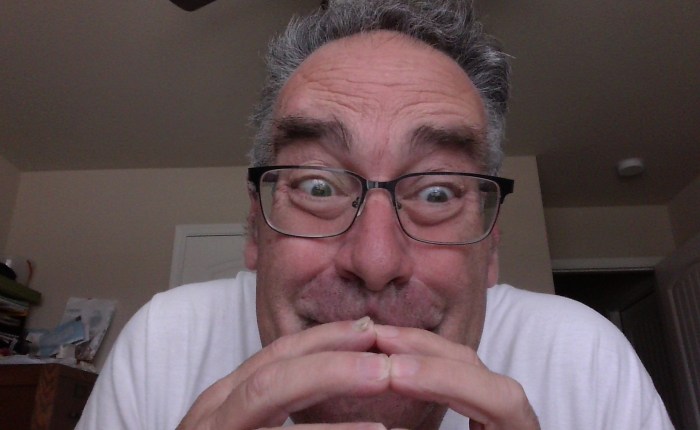
(Notice the evil grin at the top of the page!)

Be Seeing You!

Panic of the Week

Panic of the Week

Last week it was gas stoves – this week it looks like we need to be aware of the rainbows connected to the 50th anniversary of the release of Dark Side of the Moon, a recording by some rock group which incidentally stayed on Billboard’s Top 100 album chart for as long as anyone can remember. More on the record here in a bit.

But gas stoves. Seriously? The first I heard about some government agency warning about gas stoves came with the headline: “Biden Wants to Take Away Your Gas Stove!!” Yep, Joe Biden, President of the United States, to some the root of all evil (something about stealing an election by getting more votes), is set to send thousands of IRS agents to your house to confiscate your gas range! Just like Obama was poised to set government gun confiscation vans minutes after he was sworn in as President back in 2009.

Oh! The humanity!

It seems that we are bombarded by headlines from certain news sources telling us that we are on the brink of disaster on an almost weekly basis. I recall being told back sometime in October that we would run completely out of diesel fuel by Thanksgiving and that the economy would come to a standstill.

We’re still waiting on that to come to pass. Never mind that the 60-day supply of diesel fuel some portions of the media are trying to get you to panic about is what is usually on-hand and that the supply is being supplemented daily. Note, too, that the panic mysteriously went away shortly after election day.

Imagine that!

Every day there’s something trying to grab our attention – attempting to scare us into action or inaction, usually to the benefit of some group or another wanting power to… well, to twit whatever opponent they care to choose. It’s like the headline back there in the second paragraph of this little essay. There are people who dislike Joe Biden, and they love it whenever he gets even a small measure of comeuppance.

Can you say, “Classified Documents”? I knew you could!

It was pointed out the other day that time was that you had only three sources of national television news. These days, you have a multitude of sources to choose from – and people tend to choose whatever source they feel is closest to what they believe are their own views. Any source other than the chosen source is nothing but “Fake News!” Any opportunity to twit an opponent is good news – pure and wholesome, and 100% true!

Back to gas stoves.

There are risks involved in any sort of cooking as there are risks in every aspect of life. No need to panic. No one is going to come knocking at your door, wanting to confiscate your gas range.

As far as Pink Floyd’s Dark Side of the Moon, fifty years is a landmark. Even more amazing is the fact that the album remained on the Billboard Top 100 album chart quite literally for decades. (Bruce Springsteen’s first album, Greetings From Asbury Park New Jersey, also hit the 50-year mark this month. Hardly anyone noticed.) The graphic artist who created the 50-year logo included a rainbow – something seen on the album cover. All of a sudden, there was an outcry from some quarters about the rainbow, and how there was an alignment with the Gay community! Think what you will about Pink Floyd’s Magnum Opus, I really don’t think that the musicians involved in making that album were signaling the Gay community. Yet, there you go. Someone with too much time on their hands and/or a chip on their shoulder is out there making something that isn’t about a 50-year-old record album.

It’s time to light up the gas stove, make some home-made soup, and take another listen to Pink Floyd!

Be Seeing You!

Death And Llewellyn

January 12, 2023 marks 100 years since the birth of my father, Rochelle Harrell Jr. – known to his family and friends as Shelley. Unfortunately, he is not around to mark this landmark, having died at the age of 71 back in May 1994.

            Several years ago, my cousin forwarded some of my father’s writings to me, including this charming short story – Death and llewellyn. The origin of the sub-title is a riddle to me. There is no ham involved.

            The story is intact – as my father wrote it well before I was born. I made several small corrections to better the flow of the story and to correct a spelling mistake or two (he was a terrible speller). One mistake I left in was the spelling of the character at the center of this story. There is an explanation of the reasoning behind the spelling which appears early in the story.

I’m thinking that this story was some sort of a class assignment. For what class, I am not certain, as I am not certain what school he might have been attending at the time. After graduating from high school in 1941, he was a student at Virginia Military Institute until the war sent him to San Antonio to be part of the Army Air Corps. After the war, he studied at the University of Richmond. His mother wanted him (and his sister) to be a doctor – something he never did as I believe he had more the soul of an artist, as did his father.

Dad’s legacy was his six children and a certain amount of eccentricity shared and appreciated by each of us. He was quite a bit like lloyd llewellyn – which is one of the reasons I enjoy sharing this story on the occasion of his birthday.

Be Seeing You!

Death and llewellyn

Or

The President’s Virginia Ham

(Being a short story written by Shelley Harrell)

            There is no man whom I shall dislike as much as I disliked llewellyn at the end of less than three weeks.  To begin with, there was his name.  A normal man would have started his name with a capital; but no, he insisted that it was not proper to use a capital in his name.  The double letters served the same purpose.  His name should then be lloyd llewellyn – with no capitals.

            llewellyn was the last of the party we had to gather before heading into Indian Territory.  Picture our surprise when we found that he had three pack animals fully loaded with his personal effects.  He had been told that we had to travel as light as we could; there was to be taken nothing but what we needed most.  What is more, he was dressed as if he were going for a few hours ride near the town.  Red jacket, grey trousers, and jack-boots have no place in the back-woods.  This I told him.

            “Sir,” he answered, “I was told to make ready for a journey into the back-woods, and I consider myself properly attired and my equipment scarcely adequate.  If you would think that there is so much as one item that you would have me leave, the item remains here, and so do I.”  His statement rang with finality.

            At any other time, had I been spoken to so, the man should have been left standing where he was.  But here before us was the only surveyor to be found, and we were in dire need of a surveyor.  llewellyn was unaware that the best way to get into Indian Territory unmolested was with such a party as this, and the longer that he did not know the true nature of our trip, the safer we should all be.  I controlled my temper and told him to follow us.  After all, there might be some chance of some of his equipment being ‘lost’.

            I let the guide take the lead when I dropped back to talk with this strange person in the red coat.  “llewellyn, in a day or so the roads become so narrow that one can scarcely lead a pack animal, much less ride a horse.”

            “That, sir, is a misconception.  A man can ride a horse anywhere he can walk.  Your horsemanship must be poor.”  He filled his pipe and began to smoke.  “How long have you been riding?”

            “All my life,” I answered in sharp protest.

            “Your pardon, sir.  As you are the only one of the group using an Army saddle, I thought that you might have only learned to ride while you were in the service.”

            If the general had only sent me a surveyor along with my orders, all would have been much better.  But no.  This tall man who called himself llewellyn was the only surveyor to be found.  A man from West Point, or even an enlisted man, would know how to respond to discipline and how to show proper respect.  But at the end of this brief encounter, I could tell that llewellyn was the type that would do as he wished no matter what happened.  It was up to me as the leader of the party to see that his behavior did not endanger the lives of the rest of us or the purpose of the journey.  The Point should include a course in how to deal with civilians.

            That afternoon while I was pondering the best way to handle the situation, llewellyn rode to the head of the column and halted it.  Giving no explanation for his actions, he began a fire.

            “One must keep one’s strength with a cup of tea and a bit to eat, you know,” he said in answer to my questions.  I assured him that I was in command and that we could not spend our time thus.  He informed me that the better we felt the more distance we should be able to travel; and that if I had a mind to venture on, I was at liberty to do so.  He would overtake me before long.  Nothing that I could say would change his mind.  “Your orders go well with these other lads, but please.”  He offered me a place by the fire.

            “llewellyn, if we were just on a surveying party, I should be the last to make objections to resting like this.  In another day or so, we will be in dangerous territory.  Being lax for even a moment might cost us our lives.  It is for your safety and for the safety of the group that I tell you that when we stop it must be only at my order.”  He agreed to that, and then he promptly argued me into stopping for tea at the proper time each day.  His line of reasoning was most simple:  I had made the trip before and knew the average distance that could be covered.  If at the end of two days of stopping for tea we had not covered more than the average distance, tea would no longer be the order of the day.  The best way to win an argument is to let the other fellow prove to himself that he is wrong.

            The next afternoon at tea, I observed llewellyn scrutinizing the homemade boots of one of the men.  “Ever see boots like these before?” I asked.

            “No.”

            “What do you think of them?”

            “The tanning is poor and the workmanship could be called good only by a savage.  My leather goods?  From H. Sleep of London, of course.”

            “But these men could not afford such prices,” I mused.

            “Then they are not very thrifty.  I have had this pair of boots for ten years and they are still in good condition.”

            “These are military boots, are they not?” I asked.

            “Yes, I got them when I went to serve in India.”

            I hate to say this, but he turned out to be right about having tea.  When we would stop, he would take from one of the small packs a small tin which had the words ‘Twining, South Strand, London’ on its side.  Then, as he waited for the water to boil, he would start to fill his pipe (the pipe was a Barling and the tobacco Four Square, you may be sure) to tell of the wonders of India.  All remarks were made to no person in general, and he never looked to see whether or not any of us listened to what he said.  It was as if he were talking to himself; most likely he was.  Soon, after the first of such soliloquies to be exact, there was only Joe, the Indian guide, to listen to his stories.  Joe would listen with undivided attention to stories of strange forests in which a man would not dare to dismount for fear of being attacked by wild boar; of odd little men who inflicted punishment on themselves with the hope of some sort of spiritual reward; of great cities with spacious temples and grand palaces.  But the other six of us concluded that llewellyn read more than was good for him.

            In another day or so, we were forced to walk our horses as I had told llewellyn that we should; however, llewellyn never dismounted.  As an act of friendship, Joe started to demonstrate the fine art of marksmanship with his bow.  llewellyn watched cooly before remarking that the man’s aim was poor and the weapon that he used was even more primitive than the homemade boots the others wore.  No Welshman had used such a weapon since before history began.  These remarks left the man with none friendly to him.

            I deemed it my duty to tell the men the truth as to why we had gone so far into the wilderness, so the next morning I told the men that we had been sent there by the Government to make maps of the country.  More important than that, we had to make some sort of peace with a certain tribe of Indians which threatened our outposts.  Indians held mad persons as being harmless and they considered surveyors as being mad.  That was the reason for our passing as a surveying party.  Now that we were in the heart of the Indian country we should have to be more than careful in all that we did.  The watch at night would have to be changed twice as often so that the person up would be absolutely alert.  What cooking there was would have to be done in the day so there would be no light from the fire.  Only Joe would build the fires, for he knew best how to build one that would not smoke.  We should have to change camp often.  It would be best if we were to contact the Indians in day-light away from their camp and ours.  This way it would not look as if we came looking for them.

            Under my directions llewellyn set up his instruments and began to take measurements along the bank of a river.  Even as I could not but marvel at the way each piece of equipment was packed firmly in its own box.  I had seen nothing like this before.  On each box and on each instrument was the mark of C. Baker of London.  The results that llewellyn got with his equipment were excellent; they were far too good, indeed.  He charted each tree, each little bend in the river and every rise and fall in the land.  Whatever else I might think of him, I had to admire his care and exactness.  But at the rate at which he worked, it would take years to chart the land.  For three days I let him work much as he pleased.

            Other than our party, there was no sign of life.  Joe told me that only the presence of men other than ourselves would cause the wildlife to be so sparse.  I again alerted the men; at all times they were to be ready to repel an attack.  At no time were they to fire first at any Indians they saw, for we had the sanction of being surveyors.

            That very night we were captured by Indians.  When they found that we were on their land the Indians sent several parties out to keep an eye on us.  While he was on watch, llewellyn filled his pipe and lit it with a tinder box.  The light was enough to cause us to be spotted by several of our Indian ‘friends’; and before the pipe was half smoked we found ourselves surrounded and all but smothered by our foe.  In a short time their Chief came and looked at his captives.  A large council fire was built on the spot.  We were brought to the edge of the fire.

            Joe translated the angry Chief’s words for us:  “The White-men come playing to draw pictures of the ground.  That is not true; there are too many of them.”  The Chief pointed at me.  “Captain Green is sent to our land only when we displease White-men.  I shall send him back with the message that the White-men must move their cities back or we shall kill them and burn all their goods.  The rest of Captain Green’s men will be kept as slaves.”  He lifted his bronze chest with a breath of air and walked along looking at each captive in turn.  The muscles of his arms quivered with excitement as he observed us; it was obvious that he was looking for an excuse, even a slight one, to make him able to torture us to death.  He could not do this purely on the grounds that we were hunting on the land that was joint property with another tribe.  That would require calling the other tribe into the matter.

            I tried to reason with him.  My government would not violate the lands this tribe now held if the tribe would not make war on the outposts.  He required more than that; the White-men must not only ‘move their cities back’ but also must pay the tribe for keeping peace.  There was an afterthought:  the land could be bought… for a price more dear than gold.  This is what I wanted.  Now that he had shown a slight desire for bargaining, there could be hope of agreement.  Both sides would have to give in to some degree; and that, as they had taught us at the Point, is as it should be.

            “Could not trading posts be of an advantage to us both?”

            “No dealings with a cowardly people can be of an advantage to my people.”  He walked over to llewellyn.  “See how your men cower before me!”  He struck llewellyn in the face with his fist.  Being unprepared for the blow, llewellyn took it off balance and fell to the ground spitting blood.  This was great sport for the Indians; nevertheless, llewellyn found it a sorry sort of a game.  Getting to his feet he walked to the Chief.

            “Sir, you are the worst kind of coward.  I challenge you to mortal combat!”  Joe translated.

            The Chief showed great pleasure in this remark.  He could not put us to death for hunting on this land without calling in the Chief of the other tribe for a conference, but he could have us killed for attempted murder.

            “We will fight in the morning,” the Chief said.  Then he turned to me.  “Captain, am I right in thinking that it is the challenged person who has the choice of weapons in a fight of honor such as this?”  I admitted that he was.  “In such a case, each of us will have three weapons at his disposal:  scalping-knife, tomahawk and bow.  The bonds on your arms will be cut; do not be so foolish as to try to escape.”

            It was not enough that I should have been plagued with llewellyn these past days; but now that I could see that his very being would result in the downfall of all that I wished to do, the low blow had been struck.  My men had always had the highest of respect for me in the past, but now it was clear that they placed full blame on me for llewellyn’s actions.  I even blamed myself.  There was no reason for letting him be less disciplined than the others, and yet I had.  The death of all my party would be my fault.

            The wrath that the men had was in no way held back.  As slaves there would be some hope of escape.   As soon as the Chief had dispatched llewellyn, he would see to it that the rest of us would die by slow torture.  The dislike all of us held for the man in the red coat blossomed into full hate.

            llewellyn took all our abuses without a word.  As was his habit, he swung a hammock between two trees and promptly went to sleep.

            Before the first light of dawn could be seen, we were awakened from our feigned sleep and told that it was time for us to be taken to watch the duel.  llewellyn turned in his hammock and announced that he should be left one man to act as his second.  His request for Joe was granted.  Once more our hands were tied and we were led to the spot where the fight was to take place.

            By the edge of the river there was a long, flat piece of ground some sixty-five yards wide and over two-hundred yards long.  A post that was no taller than the knee-deep grass marked the center of the field.  The end of which the Chief now sat awaiting the arrival of his adversary was marked by a brightly painted skin stretched between two poles.  Along the edge of the field away from the river were the warriors of the tribe.  The area was now light enough to see that some were only in loin cloths, despite the coolness of the fall morning, and others were in blankets.  All wore war paint.  Our party was brought to a place behind the drummers who stood opposite the pole which marked the center of the field.  A yell from an unseen brave announced llewellyn’s approach.

            llewellyn was flanked by six of the tallest braves I have ever seen.  Their figure was so striking that it was some time before I took notice of the Welshman and his second.  The former was clad in blue tunic, white trousers and black boots.  His head was bound in a fantastic way with what must have been yards of blue and white cloth, and his hands were wrapped in white gauntlets that came half way to his elbows.  Joe walked behind him and carried a bow longer by a foot and a half than those I had seen before.

            llewellyn adjusted the quiver to the proper position on his back; Joe handed him his bow.  Removing the left gauntlet llewellyn slid his hand briskly along the bow for a while.  The signal for the contest to begin was given.  He returned the gauntlet to his left hand and walked with a rapid stride some twenty yards toward the Indian.  Holding up his right hand he yelled to the Chief and told him that we would not hold it against him if he were to back out of the fight at this point.  Joe translated.  The Chief boasted that he would but wound his opponent so as to be able to torture him to death.

            From the cuff of his right gauntlet, llewellyn took his pipe; he lit it and observed the way the wind blew the smoke.  He placed the pipe with care at his feet; and, after stroking the bow with his left hand he strung the weapon.  Once again he called for the Chief to surrender; once again he was told that he would be tortured.  With pleading finality in his voice llewellyn made a third try – to get the same answer.

            Swiftly the gauntlets came from his hands and an arrow was fitted across the bow-string.  The Indian was at least a hundred forty yards away when llewellyn released an arrow.  Before it had landed there were two more in the air and the fourth was half out of the quiver.  Even the Indians lost sight of the missiles as they cut their path through the sky.  One arrow fell a foot short of the Chief and a little to the right, but the next two tore through his body as if it had been made of paper.  The spectators went wild with excitement, but llewellyn retrieved his pipe and calmly walked over to cut the leather thongs that bound our hands.

            We were saved.

            An old Indian whose face was like a piece of dry leather came over and examined the Welshman’s longbow.  He was unable to pull the bow to full draw.  He handed the bow to a young brave who had the same trouble.  The old Indian made a long talk and the other Indians cheered madly.

            Some time later, I presented the President with the following letter:

            My Dear Mr. President,

                 Since the War of 1812 our countries have been at peace with each other.

                 It is my hope that they will remain so.  Recently I became elected Chief of

                 a tribe of Indians which, to that time, was hostile to the United States.

                 I have advised the tribe that war at this time is not desirable.  These men

                 Now owe their allegiance to me and I owe mine to the Crown.  Please

                 Inform the British Ambassador of this situation, which I find most awkward,

                 and have him advise me as to the policy to be followed with and by Her

                 Majesty’s latest subjects.

                                                                        Faithfully yours,

                                                                        Big Chief lloyd llewellyn, G.C.G.M.

                                                                        (Captain, Hodson’s Horse – Retired)

Old Age

Old Age

Don’t be afraid of old age – it’s a privelege denied to many” – Paraphrasing something I keep reading. I’m old and can’t rightly remember who came up with the quote or where I found it.

While organizing my thoughts this afternoon, I ran across a post on Facebook from an old colleague telling of the death of another colleague and friend from back in the day. And I really mean back in the day.

The recently departed was, in many ways, one of the smartest people I have ever worked with. He had a way with electronics (got him a scholarship to become and electrical engineer), and he had his own little way of making observations no one else could possibly make. For instance, the chief engineer at the radio station where my friend and I worked back in 1974, would purchase a bottle of Pepsi from the station’s vending machine when he began to work on something. My friend noted that the engineer would purchase more Pepsis from the vending machine as the job progressed. Within a month or so of watching that engineer, my friend would estimate how complicated a job would be by the number of bottles of Pepsi the engineer would consume. I can still hear him say that thus and such a job looks like it would be a “Three Bottle Job.”

Anyhoo, my friend is no longer among the living – no longer able to judge how many bottles of Pepsi would be needed to finish a particular job.

Interestingly enough, that friend’s name came up in conversation with a mutual friend less than two weeks ago. The mutual (and still living friend) wondered about the man and what he was up to these days. I told the mutual friend that our friend had “left the building.”

I am to the age when losing old friends is becoming more frequent. I was reminded of the death of one of my best friends to early-onset Alzheimer’s when his widow reminded me of his birthday – and that had he lived, he would be somewhere in his seventies. He barely missed being in his mid-sixties.

The girl living up the street from us when we were in high school was another Alzheimer’s victim. She was a doctor. What a waste.

There was Tim, with whom I shared an enthusiasm for all things automotive. Cancer. Early sixties.

We have all lost someone, a friend, an acquaintance, a family member – and we all mourn those passings to one degree or another. Some we will mourn for years. Others, a month or two tops. Depends a lot on the burden someone’s death places on us. I have friends who have lost children who likely will never recover. Other deaths create barely a ripple in some of our lives.

My friend who passed with Alzheimer’s will be with me for quite some time, I suppose. We were somewhat close. Interestingly enough, it was the man who “left the building” earlier this week who introduced me to the Alzheimer’s victim. I have survived them both and will continue to celebrate being an old fart.

Not many of us have that privelege, you know!

Be Seeing You!

Routines

Routines

Last Saturday I confirmed something I thought I saw coming – the breakup of my Saturday morning routine. For the past several years, my Saturday morning revolved around several radio presentations. I structured my morning routine so that I could do the laundry, letting the washer and dryer do their thing while I listened to a couple of segments of “Wheels-With Ed Wallace” and the NPR show “Wait Wait, Don’t Tell Me.” Ed announced that last Saturday morning would be his last day doing Wheels.

There goes an hour of my Saturday morning routine.

Wheels is an advertising vehicle for select automobile dealerships here in the Metromess. The show could be one long, boring program length commercial run by a former car salesman; instead it’s a bit of a variety show run by a former car salesman. Calling out Mr. Wallace as a former car salesman (which he was) is doing the man a disservice. Yes, there’s car talk out there, but what I listened for were a couple of features which he ran as part of the show.

At about 8:30, Ed ran a relatively short feature about the history of Rock and Roll. Stories about groups, individual performers, and stories about radio itself were featured. I cannot say that I was ever bored with Ed Wallace’s Saturday morning college of rock and roll knowledge. Many times he would tell of the background of a performer who had recently died. This past Saturday he presented a vignette of the man who came up with the term “Oldies but Goodies,” a radio veteran who passed earlier in October.

Around 9:10 or so, Ed ran a segment he called “The Backside of American History.” As with the rock and roll segment, he featured well-researched stories not usually found in history books. My favorite story was one he told just before Christmas each year about the Santa Claus Bank Robbery… a shoot-em-up story about a pre-Christmas bank robbery pulled off by a burglar in a Santa Claus suit in Cisco Texas.

It was at the end of this week’s final part of a three-part story about legendary CBS journalist Edward R. Murrow that Ed confirmed that he was doing his last show.

Frankly, I don’t blame the man for stepping away from the microphone. He’s either just turned or is pushing seventy awfully hard and he deserves a break from a job well done.

Still, I am almost at a loss as to what to do in that hour or so on a Saturday morning. Maybe I can find another something to latch onto for my appointment radio fix.

Yes, I said appointment.

Many of us have certain media appointments through the week. I knew a family back in the day who gathered faithfully on Saturday nights to watch “Mission: Impossible.” One of my good friends would drop everything he was doing to watch what he called, “Book ’em,” better known as “Hawaii Five-O.” I’ve had similar appointments with several other shows – and have current appointments with “Ghosts,” “Svengoolie,” and several re-runs of older shows, like “Batman” with Adam West (is there any other?).

I’ve had Saturday morning radio appointments with “What Do You Know,” “Car Talk (with Tom and Ray),” and almost had an appointment with Tom Bodett’s “End of the Road” radio series. I caught the last episode of “End of the Road,” ended up finding and reading the book he wrote incorporating the stories he told on the radio. Bodett occasionally shows up on “Wait Wait Don’t Tell Me” as a panelist, and still can be heard from time to time advertising Motel 6 (We’ll leave the light on for you).

I will most likely find something else worth listening to while doing laundry and other household chores on Saturday morning. Still, there will be a hole left with Ed Wallace parting company with Wheels. Good job, Ed. Never met you, but I sure will miss you!

Be Seeing You!